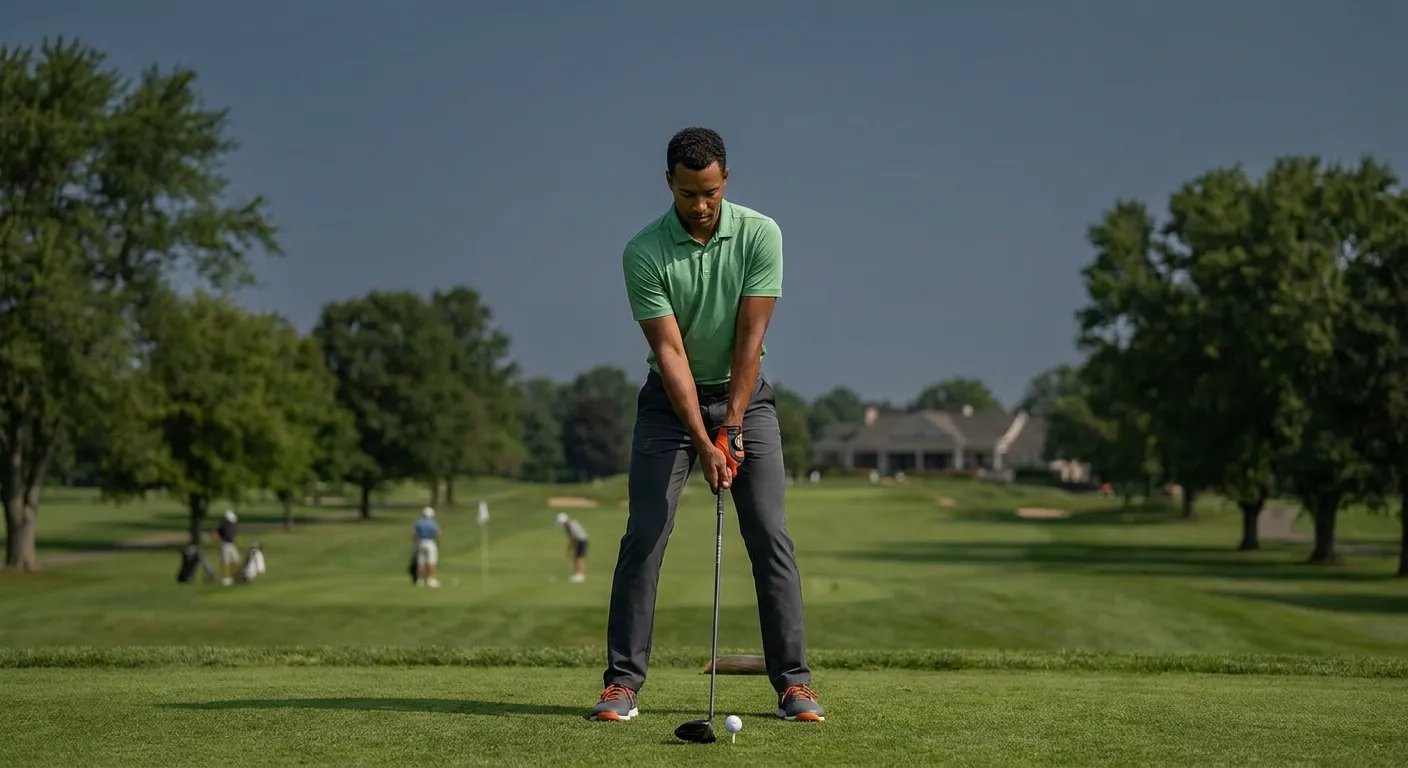
A solid golf stance is the bedrock of a consistent golf swing. Indeed, it is the foundation from which all movement originates, directly influencing balance, power, and accuracy. Without a proper setup, even the most dedicated practice can lead to unpredictable results. For beginners and intermediate players alike, mastering golf stance fundamentals is a critical step towards improving ball striking and overall game performance. Therefore, understanding these core principles will significantly elevate your game.
Understanding the Core of a Great Golf Stance
Your golf stance begins even before you address the ball. Proper posture is undoubtedly key to a successful setup. Initially, stand tall with your feet about hip-width apart. Then, bend from your hips, not your waist, allowing your arms to hang naturally. Your knees should have a slight flex, feeling athletic and ready to move. This athletic posture creates a stable and dynamic base for your swing. Furthermore, it helps in maintaining balance throughout the entire motion.
Next, consider your foot placement. For most full swings, your feet should be roughly shoulder-width apart, providing optimal balance and stability. The precise ball position will vary depending on the club you are using. Generally, for drivers, the ball should be further forward, typically off the lead heel. Conversely, for irons, the ball should be more centered in your stance. Experimenting slightly within these guidelines will help you find what feels most natural and powerful for your unique body type. This personalization is vital for consistency.
Weight distribution is another vital component of mastering golf stance fundamentals. For a standard iron shot, aim for an even weight distribution (50/50) between your feet at address. However, for a driver, you might favor slightly more weight on your trail side (e.g., 60/40) to encourage an upward strike. Your head should remain still, looking at the ball, with your chin slightly up to allow for a full shoulder turn. Ensuring your shoulders, hips, and feet are aligned parallel to your target line is crucial; this is often referred to as being “square” to the target. Many golfers find it helpful to pick an intermediate target a few feet in front of the ball to assist with this alignment.
Setting Up for Success: Key Elements of Your Golf Stance
Achieving a great golf stance involves more than just foot and ball position. It encompasses a holistic approach to your body’s interaction with the club and the ground. For instance, your grip also plays a significant role in how your arms and shoulders align. A neutral grip allows for natural wrist hinge and rotation. Moreover, the distance you stand from the ball directly impacts your swing plane. If you stand too close, you might feel cramped; too far, and you’ll reach, both leading to compensations. Your arms should hang freely from your shoulders, not reaching or being pulled in tight. This natural hanging position promotes a relaxed and powerful swing. Additionally, consider the subtle tilt of your shoulders. For most golfers, the lead shoulder should be slightly higher than the trail shoulder at address, especially with a driver. This slight tilt helps in setting up an effective swing path.
Developing a repeatable and effective golf stance takes practice, but the effort is well worth it. A consistent setup allows your body to perform the swing mechanics more efficiently, leading to better contact, increased power, and more predictable ball flight. Focus on these fundamentals, and you will build a strong foundation for a more confident and effective golf swing. Furthermore, regular practice of your setup routine will ingrain these habits, making them second nature on the course.
The Role of Posture in Your Golf Stance
Your posture is perhaps the most overlooked yet critical aspect of your golf stance. It dictates your balance, ability to rotate, and ultimately, your power. Begin by standing tall, feeling stretched. Then, soften your knees slightly, creating an athletic bend. Importantly, hinge forward from your hips, not your lower back. This action should bring your chest over the ball while keeping your spine relatively straight. Your arms should hang freely from your shoulders, creating a natural triangle with your shoulders and the club. This relaxed arm position prevents tension, which can be detrimental to your swing. Many golfers find it useful to imagine sitting back slightly, as if into a chair, to achieve the correct hip hinge. This posture ensures that your weight is distributed towards the balls of your feet, providing stability without being rigid. Proper posture is a non-negotiable part of solid golf stance fundamentals.
Foot Placement and Ball Position: A Club-by-Club Guide
The placement of your feet and the ball’s position relative to them are fundamental to striking the ball effectively with different clubs. Generally, for a driver, the ball should be positioned off the heel of your lead foot. This forward placement allows for an upward strike, which is ideal for maximizing distance and reducing spin with the driver. Your feet should be slightly wider than shoulder-width apart to provide a stable base for the powerful driver swing. Conversely, for irons, the ball position progressively moves towards the center of your stance as the club gets shorter. For long irons (e.g., 3-iron), the ball might be just inside your lead heel. For mid-irons (e.g., 7-iron), it’s typically in the middle of your stance. For short irons and wedges, the ball might be slightly behind center. This adjustment ensures a downward strike for irons, promoting clean contact and control. Your foot width for irons should generally be shoulder-width apart, offering a balanced blend of stability and mobility. Understanding these nuances is key to consistent ball striking and is a vital part of mastering golf stance fundamentals. For more insights on equipment, consider exploring our guide on Golf Club selection.
Achieving Proper Alignment: Square to the Target
Alignment is a crucial, yet often overlooked, element of a good golf stance. Being properly aligned means that your shoulders, hips, and feet are all parallel to your target line. Many amateur golfers mistakenly align their body directly at the target, which often leads to an open stance and shots pulled to the left (for right-handed golfers). To ensure proper alignment, it is helpful to pick an intermediate target a few feet in front of the ball that lies directly on your target line. Then, align your clubface to that intermediate target first. After that, align your body parallel to the clubface. This two-step process helps to ensure your body is square to the target. Furthermore, practicing with alignment sticks on the range can provide immediate feedback and help you ingrain the feeling of proper alignment. Remember, your eyes can deceive you, so external aids are often beneficial. Consistent alignment is foundational to directing your shots accurately and reinforces effective golf stance fundamentals. Mastering this aspect will significantly improve your shot direction.
Weight Distribution for Power and Control
The correct weight distribution in your golf stance is critical for generating power and maintaining control throughout your swing. For most iron shots, an even 50/50 weight distribution between your lead and trail foot at address is ideal. This balanced setup allows for a stable base from which to rotate and deliver the club. However, when hitting a driver, a slight shift in weight to your trail side (e.g., 60% on the trail foot, 40% on the lead foot) is often beneficial. This subtle shift encourages an upward angle of attack, which is optimal for maximizing distance with the driver. Conversely, for short game shots like chipping, you might want more weight on your lead foot (e.g., 60/40 lead to trail) to promote a steeper, more controlled strike. The key is to feel athletic and balanced, not rigid. Experimenting with these distributions on the practice range will help you discover what works best for your swing and specific shot requirements. Proper weight distribution is a cornerstone of effective golf stance fundamentals.
Common Golf Stance Mistakes to Avoid
Many golfers inadvertently adopt poor stance habits that hinder their performance. One common mistake is standing too far from or too close to the ball. Standing too far often leads to reaching, causing a loss of balance and inconsistent contact. Conversely, standing too close can make you feel cramped, restricting your swing path. Another frequent error is an overly stiff or rigid posture. A golf stance should feel athletic and ready to move, with soft knees and a relaxed grip, not like a statue. Tension in the arms and shoulders is also a major culprit, preventing a full and free swing. Improper alignment, as discussed earlier, is another prevalent issue. Many golfers unknowingly aim left or right of their target. Furthermore, inconsistent ball position for different clubs can lead to varied results. Always ensure your ball position matches the club you are using. By consciously avoiding these common pitfalls, you can significantly improve your setup and, consequently, your overall game. Addressing these issues strengthens your understanding of golf stance fundamentals.
Drills to Improve Your Golf Stance
Improving your golf stance requires deliberate practice. Here are a few drills to help you solidify your setup: First, the “Mirror Drill.” Set up in front of a full-length mirror and observe your posture, alignment, and arm hang. This visual feedback is invaluable for making immediate adjustments. Second, use alignment sticks. Place one stick on the ground pointing at your target line and another parallel to it where your feet will be. This helps ensure your body is square. Third, the “Feel for Balance” drill. Stand in your golf stance without a club, close your eyes, and notice where your weight is distributed. Try to feel a balanced pressure in the balls of your feet. Fourth, the “Club-Behind-Back” drill for posture. Hold a club across your back, touching your tailbone and the back of your head. Hinge from your hips, keeping both points of contact, to ensure a straight spine. These drills, when practiced regularly, will ingrain the correct sensations and positions, making your golf stance more consistent and effective. Consistent practice of these golf stance fundamentals will pay dividends on the course.
The Connection Between Stance and Swing Path
Your golf stance profoundly influences your swing path. A correct setup encourages an optimal path, while a flawed stance can force compensations. For example, if you set up with an open stance (feet and shoulders aimed left of the target for a right-handed golfer), your body is pre-disposed to an outside-in swing path. This often results in slices or pulls. Conversely, a closed stance (aimed right of the target) can promote an inside-out path, leading to hooks or pushes. The proper athletic posture, with the correct hip hinge and knee flex, allows for a full and unrestricted shoulder turn in the backswing and an unimpeded release in the downswing. Furthermore, maintaining a stable base through proper foot placement prevents excessive sway or slide, which can throw off your swing plane. The relationship is symbiotic: a good stance facilitates a good swing path, and a consistent swing path reinforces the importance of a solid stance. Therefore, understanding these golf stance fundamentals is paramount for developing a reliable swing path. You might also find value in using a Golf Tracker and Swing Analyzer to get real-time feedback on your swing path.
Customizing Your Golf Stance for Different Shots
While fundamental principles remain consistent, your golf stance isn’t a one-size-fits-all solution for every shot. Slight adjustments are necessary depending on the situation. For example, when hitting a fairway wood or hybrid, your ball position might be slightly more forward than an iron, but not as far forward as a driver, to encourage a sweeping motion. For bunker shots, you’ll typically adopt an open stance with more weight on your lead foot, and dig your feet into the sand for stability. This helps create a steeper angle of attack. For chip shots around the green, a narrower stance with closer feet and more weight on the lead side is common, promoting a descending blow. Even for uphill or downhill lies, your stance will need to adapt. On an uphill lie, you might tilt your shoulders to match the slope, and for a downhill lie, you’ll lean slightly into the slope. Understanding how to subtly modify your golf stance fundamentals for various scenarios is a mark of an advanced golfer. This adaptability allows you to tackle any shot with confidence and precision. For more specialized gear, check out our guide on Golf Gloves.
The Mental Aspect of a Consistent Stance
Beyond the physical mechanics, the mental aspect of your golf stance is equally significant. A consistent pre-shot routine that includes setting up properly can instill confidence and reduce anxiety. When you step up to the ball knowing your stance is solid, you free your mind to focus on the shot itself, rather than worrying about your setup. This routine helps create a mental anchor, signaling to your brain that it’s time to execute. Conversely, rushing your setup or neglecting your stance fundamentals can lead to mental uncertainty, which often translates into physical errors. Taking a moment to breathe, visualize the shot, and then consciously build your stance can make a huge difference. Furthermore, trusting your setup once you’ve established it is crucial. Don’t second-guess yourself after you’ve committed to your alignment and posture. The mental game is just as important as the physical, and a strong, consistent stance is a powerful tool in your mental arsenal. Reinforcing these golf stance fundamentals mentally will enhance your overall performance. For additional resources, consider exploring expert advice on golf techniques. Golf Distillery’s Stance Tips offers further reading on improving your setup. Additionally, the USGA’s Rules of Golf, Rule 10 provides official guidance on how to play a ball, including aspects related to stance and address.
Conclusion: The Foundation of Your Golf Game
Mastering your golf stance fundamentals is not merely about achieving a static position; it’s about creating an athletic, balanced, and repeatable foundation for every swing. From proper posture and precise ball position to accurate alignment and effective weight distribution, each element plays a crucial role in shaping your shot. By consistently applying these principles, avoiding common mistakes, and practicing dedicated drills, you will build a robust setup that fosters consistency, power, and accuracy. Remember, a great golf swing starts from the ground up, and your stance is that vital first step. Embrace these fundamentals, and watch your game transform, becoming more enjoyable and effective with every round. This commitment to your setup will undeniably lead to significant improvements in your overall golf performance. For additional insights on maintaining your game, explore our articles on Golf Shoes.
FAQ
What is the most important part of a golf setup?
The most important part of a golf setup is a balanced and athletic posture. This includes bending from your hips, having a slight knee flex, and allowing your arms to hang naturally. This foundational posture enables proper rotation and power generation throughout the swing.
How far should feet be apart in a golf stance?
For most full swings with irons, your feet should be approximately shoulder-width apart. When using a driver, a slightly wider stance, just outside shoulder-width, provides more stability for the powerful swing. For short game shots, a narrower stance is often preferred.
Where should the golf ball be in your stance?
The golf ball position varies by club. For a driver, it should be off the heel of your lead foot. For mid-irons, the ball is generally in the center of your stance. For short irons and wedges, it moves slightly behind the center. Adjusting ball position helps achieve the correct angle of attack for each club.
How do I check my golf alignment?
To check your golf alignment, pick an intermediate target a few feet in front of the ball that is directly on your target line. Align your clubface to this intermediate target first, then align your body (feet, hips, shoulders) parallel to the clubface. Using alignment sticks during practice can also provide excellent visual feedback.
Should weight be on heels or balls of feet in golf?
In a proper golf stance, your weight should be balanced towards the balls of your feet. This athletic distribution allows for dynamic movement and balance throughout the swing. Avoid having too much weight on your heels or toes, as this can lead to instability and difficulty in maintaining balance.