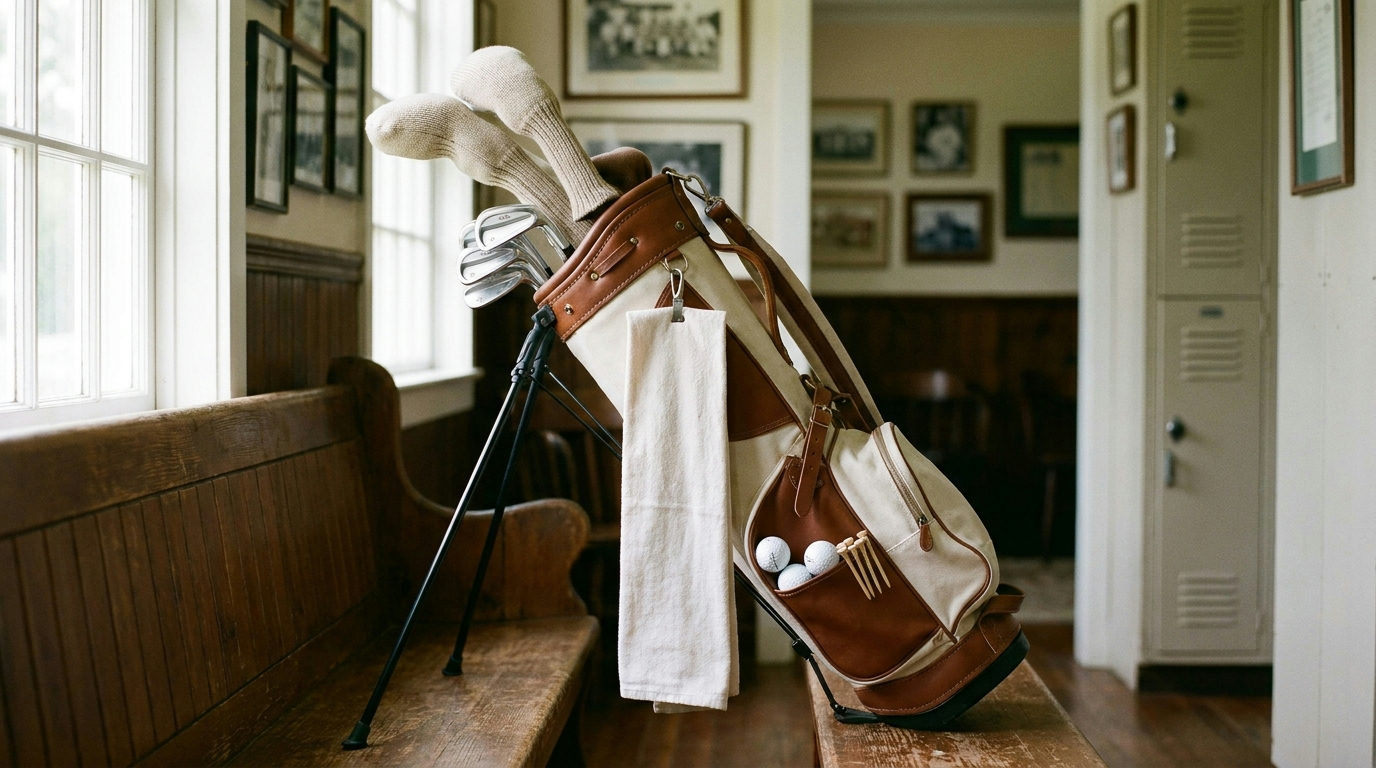
Knowing how to organize a golf bag saves time on every hole and takes a little stress out of your round. When each club and accessory has a set home, you can grab what you need quickly and spot anything missing before you tee off. This guide covers dividers, a sensible club order, a pocket-by-pocket checklist and what to take out.
Who this guide is for
This guide is for beginners putting together their first full bag and for regular players whose bag has slowly filled with clutter. It works for both carry and cart players. You will not need to buy anything new to learn how to organize a golf bag. The aim is simply to use the bag you already own in a clearer, more consistent way.
Start by emptying everything out
The first step in how to organize a golf bag is to start from a clean slate. Pick a clear space at home, such as a table or the floor, and follow these steps.
- Take every club out. Lay them in a line so you can see your full set.
- Empty every pocket. Turn each one inside out and shake out sand, grass and old tees.
- Sort items into piles. Group balls, tees, markers, gloves, clothing, food and everything else.
- Clean the bag. Wipe the outside, brush out the dividers and let any damp pockets dry fully.
- Decide what goes back in. Use the checklists below to choose what earns a place.
Doing this once properly makes the regular tidy-ups much faster afterwards.
Understanding the dividers
The top of your bag is split into sections by dividers. They stop clubs from tangling and help protect the grips and shafts. Bags vary, but many follow a similar pattern.
- Top section. This is the row closest to the bag’s spine, nearest the strap or handle. It usually holds the longest clubs.
- Middle sections. These are often split into left and right sides and hold your mid-length clubs.
- Bottom section. This row sits furthest from the spine and suits your shortest clubs.
- Putter well. Some bags have a dedicated slot for the putter, often at the top or side.
- Full-length dividers. Some bags carry each divider down the full length of the bag, which keeps each club in its own channel.
Before you load clubs, take a moment to look at how your own bag is laid out. That will guide where each group of clubs goes.
How to organize a golf bag: a sensible club order
There is no single correct layout, but a consistent order makes life easier. The general idea is to place longer clubs near the top and shorter clubs toward the bottom, so the heads do not hide each other.
- Woods at the top. Put your driver, fairway woods and hybrids in the top section, closest to the spine.
- Long irons next. Place your longest irons in one of the middle sections.
- Mid irons beside them. Put your mid irons in the other middle section, in number order.
- Short irons and wedges at the bottom. Keep your highest-numbered irons and wedges together in the bottom row.
- Putter in its own spot. Many golfers keep the putter in the top section or a dedicated putter well. That way it is easy to grab on every green.
Within each section, keep the clubs in number order. As a result, you will spot a missing club at a glance. Once you settle on a layout, use the same one every round so your hands learn where to reach. If you are adding clubs to your set, check the official Rules of Golf on what you may carry.
How to organize a golf bag pocket by pocket
Pockets differ from bag to bag, so match these groups to the pockets you have. This is where knowing how to organize a golf bag pays off most. The key is to give each group one home and keep it there.
| What goes in it | Why it helps | |
|---|---|---|
| Ball pocket (usually large and low) | A sensible supply of balls for your level | Easy to reach and easy to see when you are running low |
| Small accessory pocket | Tees, ball markers, a repair tool, a pencil | Everything you need on the tee and green in one place |
| Glove pocket or clip | Your current glove and a spare | Keeps gloves flat and dry between shots |
| Valuables pocket (often lined) | Phone, keys, wallet | Keeps valuables protected and out of the way |
| Apparel pocket (long side pocket) | Rain jacket, waterproof trousers, a spare layer, a hat | Lets you react to weather without searching |
| Cooler or top pocket | Water and snacks | Quick access between holes |
| Side or bottom pocket | First-aid basics such as plasters and sun cream | Small items that are handy but rarely needed |
| Outside clips and loops | Towel, umbrella | Ready to use without opening any pocket |
Tips for each item
- Balls. Carry enough for your usual round plus a few spares. Too many just adds weight.
- Tees and markers. Keep a small handful of tees in your pocket each hole, then restock from the bag.
- Repair tool. Store it with your markers so you remember to fix ball marks on every green.
- Towel. Clip it where you can reach it with either hand, and keep it damp on dry days if you like a clean clubface.
- Rain gear. Fold it neatly so it does not tangle with other items.
- Snacks and water. Choose sealed bottles and wrapped snacks to avoid spills.
What to remove
Cluttered bags often carry items that never get used. Clear these out during your clean-up:
- Scuffed or cut balls you would not choose to play.
- Broken tees and tees in sizes you never use.
- Old, stiff or torn gloves.
- Scorecards, receipts and wrappers from past rounds.
- Extra towels beyond the one or two you actually use.
- Out-of-season clothing you will not need for a while.
- Duplicate tools, pencils and markers.
A lighter, tidier bag is easier to carry and easier to search. In addition, it means less rummaging on the tee while your group waits.
Cart bag vs stand bag
Before deciding how to organize a golf bag, think about which type you use. Here is how the two main styles differ.
| Feature | Cart bag | Stand bag |
|---|---|---|
| Typical use | Riding in a cart or using a push trolley | Carrying on your shoulders |
| Dividers | Often more sections and full-length dividers | Often fewer sections to save weight |
| Pocket layout | Pockets often face forward so you can reach them while the bag is strapped in | Pockets spread around the bag and can be harder to reach when it is standing |
| Packing approach | Room for extras, but keep the front pockets for what you use most | Pack light and keep only essentials |
| Club order tip | Put the putter where the cart strap will not block it | Keep the longest clubs near the spine so the bag feels balanced |
If you use a cart bag, check that the strap does not cover any pocket you need during the round. With a stand bag, weight matters more, so be stricter about what you pack.
This example is hypothetical. Imagine a golfer whose stand bag feels heavy and messy. He empties it out and finds a pile of old balls, three towels and a jacket he has not worn in months. He keeps a modest ball supply, one towel and his rain gear, then sets his clubs in number order from top to bottom. On his next round he finds each item first time and the bag feels noticeably lighter on his shoulders.
Pre-round checklist
Run through this quick table before you leave home or the car park.
| Check | What to look for | Done? |
|---|---|---|
| Clubs | All clubs present and in their usual slots | Yes / No |
| Balls | Enough for the round, plus a few spares | Yes / No |
| Tees and markers | A handful of tees and at least one marker | Yes / No |
| Repair tool | In the accessory pocket | Yes / No |
| Glove | One in use and a spare if it might rain | Yes / No |
| Towel | Clipped on and clean | Yes / No |
| Weather gear | Rain jacket, umbrella or extra layer as needed | Yes / No |
| Water and snacks | Packed and sealed | Yes / No |
| First-aid basics | Plasters and sun cream | Yes / No |
| Valuables | Zipped into the valuables pocket | Yes / No |
Common mistakes
- Changing the layout every round. Pick one order and stick to it.
- Overpacking balls. Carry what you realistically need.
- Mixing clothing with small items. Keep apparel in its own pocket so tees and markers do not get lost.
- Leaving damp gear inside. Unpack wet towels and rain gear after each round so they can dry.
- Skipping the post-round tidy. Spend a minute restocking and clearing rubbish when you get home.
For more practical advice, visit our Beginners Corner.
Where to read more: Golf Monthly on organising a golf bag, GOLF.com on organising your golf bag.
Key takeaways
- Empty the bag fully before you reorganise it.
- Place woods at the top, irons in number order, wedges at the bottom and the putter where you can reach it easily.
- Give each group of items one pocket and keep it there.
- Remove old balls, broken tees, spare towels and rubbish.
- Use the pre-round checklist so nothing is missing on the first tee.
Once you know how to organize a golf bag and keep it that way, every round starts calmer and runs more smoothly.
Written by the Golf Luxor Editorial desk. Disclosure: this guide contains no affiliate or sponsored links.